
Sep 9
Nadia’s Journey into Deer Stalking, Food Security and Self-Sufficiency
For Nadia, deer stalking began with a simple question: how could she take greater control over the food she was putting on her family’s table? What started as a search for healthy, local and responsibly sourced food quickly developed into something much bigger. In just 14 months, the 49-year-old mother of two has gone from having no experience of deer stalking to completing a series of qualifications in stalking, gralloching, butchery and advanced deer management. Along the way, she has discovered a new connection with the countryside, a deeper understanding of wildlife management and a determination to pass practical skills on to her children. Now, she hopes her journey will encourage more women to step into the field and discover what deer stalking can offer them too.
PDS1 Practical Assessment
About Nadia
I am a 49-year-old married mother of two primary-school-aged children. My family is a huge part of my life: my older brother and my parents live nearby, and my children are at the centre of everything I do.
I am a registered fitness professional with a wide range of experience, including working with children in a care home setting, delivering fitness classes, supporting NHS GP referral patients, and working as a tutor and fitness assessor for a fitness academy.
Health and fitness have always been a major part of my life. I competed in artistic gymnastics for Scotland from a young age and trained with the British team. Later in life, I competed in natural bodybuilding, winning an amateur world champion title in 2013 before taking pro status.
I have always enjoyed outdoor pursuits, including road cycling, although family life means I struggle to find the time for that now.
• I value discipline, awareness and honesty, both in my own life and as a parent.
• I am open with my children about the world around them and encourage them to question things rather than simply accept them.
• I want my family to understand where food comes from and why food choices matter.
• I would love to connect with other women, especially mothers, who want more control over the food they eat and feed their families.
Why I Became Interested in Deer Stalking
My interest began with one main concern: healthy food security. I wanted access to local, natural, free-range food and a better understanding of how to provide for my family in a way that felt responsible and sustainable.
I have become increasingly concerned about the availability and cost of organic, local and naturally produced food. So much of what is available now feels controlled by large corporations, transported long distances, or produced using methods I am not comfortable with. For me, this raised important questions about health, sustainability and the future food choices available to the next generation.
The more I have researched where our food comes from, what ingredients are used, and how little transparency there can be, the less confidence I have in the food system. I have also become concerned about the push towards genetically modified foods. This is not about conspiracy theories. There have been court cases in the UK and EU about these issues, and I feel governments allow large corporations to mislead the public. As a result, I lost trust in the food I was feeding my family. I changed where I shop and now avoid supermarkets unless I buy tinned food. Instead, I use local butchers, fruit and vegetable shops, and farm shops.
That concern pushed me to learn how to source food more independently. Deer stalking, alongside growing fruit and vegetables, became part of a bigger goal: to protect my family’s health, teach my children practical skills, and help them understand the importance of knowing where their food comes from. For me, the only true way to know where my food comes from is to hunt it and grow it myself. I am also keen to learn traditional food preservation methods, and eventually I would love to have a beehive too.
The more I looked into it, the more I realised how far we have moved away from ethical harvesting, and I believe much of that comes from decisions made by powerful people that are outside our control and not always in our best interests. It made me see that changing the way I live gives me more control over my future. Many people have returned to the practical ways their grandparents or great-grandparents lived, and I admire that. If they can adapt, so can I. I believe we need to come together and find better ways to live, especially for the environment. In my view, that means learning from the generations before us.
Passing It On to My Children
As a mother, this connects deeply with the way I want to feed my family. It takes me back to my childhood, when my grandparents grew their own fruit and vegetables. I remember the taste of their tomatoes, grapes, and strawberries, watching food grow in the garden, and helping them pick vegetables for dinner. I grew up in that house, and I have recently built a large polytunnel on the same piece of land where they used to grow food. I am bringing back those memories and passing that heritage on to my children. I know my grandparents would be proud, and that gives me even more joy in working hard to give my family what I had.
My decision to hunt and grow my own food comes back to my children’s future. I feel responsible for doing what I can to help them live as independently as possible. If I learn these skills now, I can pass them on. Genetically modified and “fake” foods are already here, but many people do not realise it. I do not think people ask enough questions, such as why so many people seem to be sicker than ever in the 21st century. With all the experts and advances in science, should we not be healthier?
How I Felt Before Starting
Before I started, I felt ready. I was not nervous or unsure; I was focused. I wanted to step up and do something meaningful because I was concerned about my children’s future and our family’s health.
Fourteen months later, I am writing this because I would love to encourage other women to get involved. I want to work alongside other female deer stalkers so we can support one another, hunt for food, grow food, and build a stronger connection with local, fresh and chemical-free food sources.
Once I made the decision, the first step was straightforward: I looked for a reputable course that I could attend as soon as possible.
Why Learning Properly Was Important
For me, it had to be done properly from the start. If I am going to commit to something, I want to do it right.
Proper training matters because it reduces risk to people and animals. Deer stalking is not just about taking a shot; it involves responsibility, judgement, animal welfare, food hygiene and respect for the wider environment.
I also needed to know that the deer I brought to the dinner table was safe for my family to eat. Learning how to assess deer health, gralloch correctly, butcher safely and recognise signs of disease made Level 2 essential for me.
I did not expect to continue with so many courses, but I became genuinely interested in the learning. Deer management is about far more than shot placement. It also involves ecosystems, other species, habitats, farming, soil and the long-term balance of the environment.
After completing Level 2 theory, I continued with an airgun proficiency course. It was not originally on my radar, but I felt that improving my shooting skills with small animals could support both deer stalking proficiency and pest control.
I also practise target shooting regularly so that my skills remain consistent, challenged and improving. Consistency is key to humane outcomes. I will not take gambling shots: if I am not sure or confident, I do not take the shot.
Doing things properly also means thinking about the next generation and the long-term future of wildlife. The animals and their place in the landscape must be respected.
I did not go into this just to “give it a go”. My family would agree that once I put my mind to something, I commit fully. My brother once said, “When Nadia puts her mind to doing something, she will do it.” He knew that one day I would be cooking a deer I had shot myself.
I knew deer numbers needed to be controlled, but I did not fully understand the wider ecological impact until I began studying. Learning how overpopulation can affect habitats, bird species, plants, soil and farmers has been fascinating. I now enjoy sharing what I have learned about deer stalking and deer management with others.
What I have studied, passed and achieved in the field within 14 months shows my determination to do this properly. This was never a passing interest for me.
Courses Completed So Far
To date, I have completed six main courses, along with first aid and forestry-related training:
• Butchery
• Night shooting training, which I am about to begin
Online Learning and Academy Support
I have found the online course videos extremely helpful. The modules are broken down clearly, which makes it easy to revisit topics for revision. Being able to download exam papers and correct mistakes has also been valuable.
The academy support team has also been excellent. Whenever I email, they reply quickly and professionally, while still being friendly and approachable. I have never felt like a pest for asking questions.
Advanced Deer Management
Advanced Deer Management has been my favourite course so far, partly because it was the hardest. I felt stressed during the exam, but the satisfaction of achieving something so challenging made it especially rewarding. With 17 modules covering topics I knew very little about before starting, the course gave me a much deeper understanding of what “management” truly means.
Click the Image below to find out more.
Click the Image below to find out more.
Proficient Deer Stalker Level 2 (PDS2)
I enjoyed the Level 2 modules, but I especially valued the practical assessments. My strengths are practical skills rather than academic. Leading the stalks and observing the animals in the field, followed by assessing deer health, have been among the most interesting parts of the experience.
I did not expect to become so passionate about deer stalking. It has become more than food security, which is why I have continued to study further, through the Shooting and Hunting Academy course, into why deer management is so important.
Click the Image below to find out more.

My Mentors: Chris and Rab
I should add that the mentoring from both Chris Daton and Rab Millar has been mind-blowing in many ways. They have been so supportive, making me feel confident. I can ask them anything and never feel stupid for asking. They clearly want to support more women into the field for hunting.
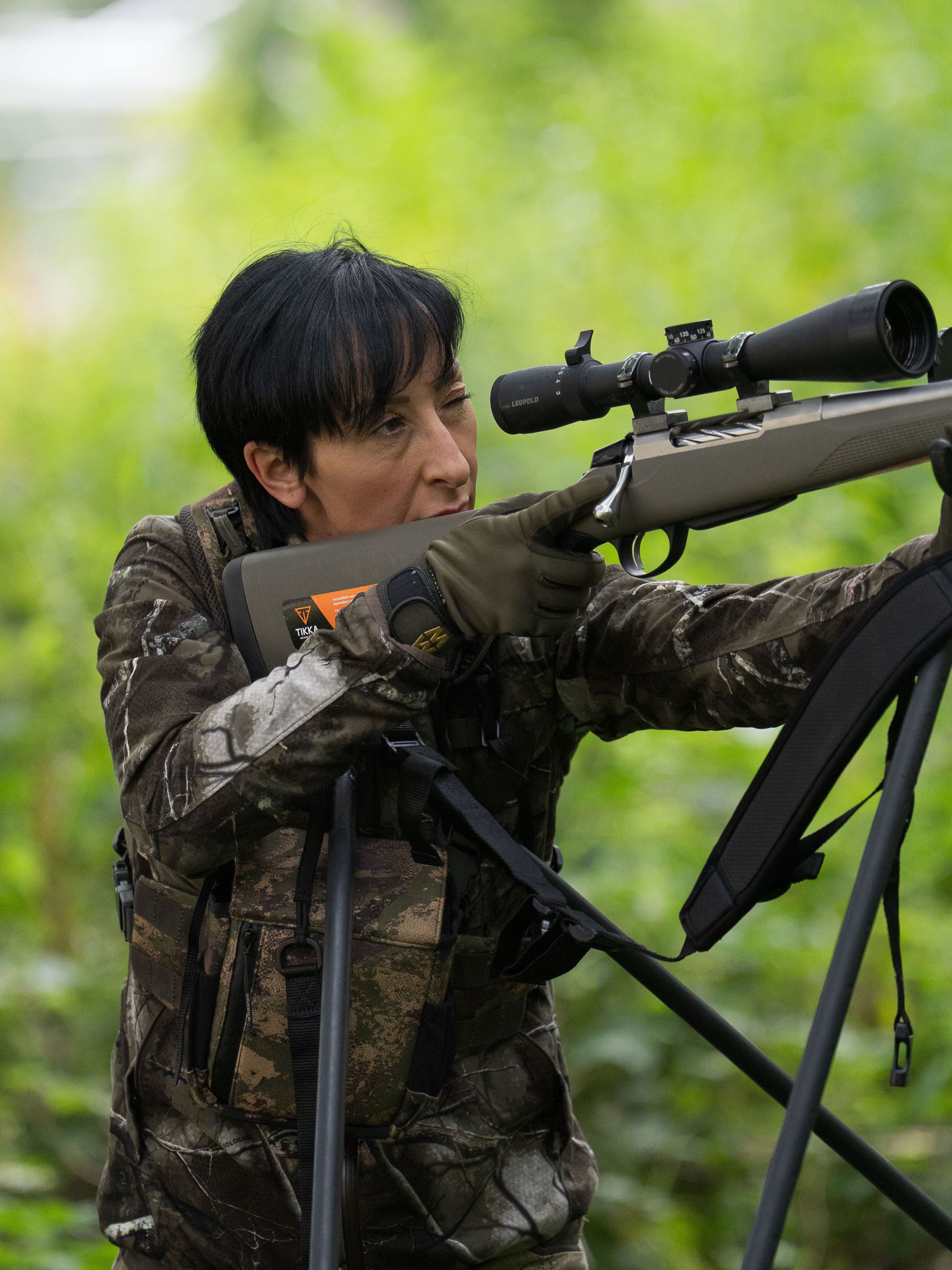
Meeting Chris took my enthusiasm to the next level, and I instantly felt my confidence rise. Not only have they both taught me so much in the field, with training still ongoing, but Rab has also helped me learn how to put a scope on my rifle and adjust it for long-distance shooting as well as pest control shooting. Without a doubt, they have been two amazing mentors. I am very lucky that Chris and Rab took me on. It pays to work with top-class instructors, especially if you are coming into this with zero experience. I will be continuing my training with Chris and Rab and completing more courses at the academy.
Gralloching, Butchery and Growing Food
Knowing that I can assess a deer’s organs and lymph nodes, then butcher, cook and feed my family from that animal, feels deeply meaningful. Winning medals in sport gave me a buzz, but harvesting my own food feels more significant. Being able to demonstrate these skills to my children and let them learn from me gives me enormous satisfaction.
What Stalking Has Given Me
Stalking is physically and mentally challenging: it requires constant concentration, walking around for three hours on uneven ground, and then, if you get a deer, the process of gralloching followed by carefully dragging the deer over uneven ground back to the car. But there is also another side to it: observing wildlife, listening to nature and being surrounded by stunning, peaceful countryside.
My life is constant rushing around and I am full of beans and noise, but in the field, deer stalking, you cannot rush or make noise, and that in itself has been a massive thing for the inner peace I have been needing to find. I did not realise how wonderful it can feel to take things slowly and quietly. Moving around in nature with other animals close by is blissful. Even when I come home without a deer, the fresh air leaves my head feeling clear and my body feeling relaxed. The deer stalking experience truly has been very beneficial in so many ways.
I did not realise how strong the connection between fitness, the outdoors and deer stalking was until my first stalk in the field. From that moment, it made complete sense to me. After having children, my outdoor hobbies slowly disappeared. Cycling became impossible, and even going for walks stopped happening. Deer stalking has given me a reason to get back outside, and my two Jack Russells have helped bring walks back into my routine too.
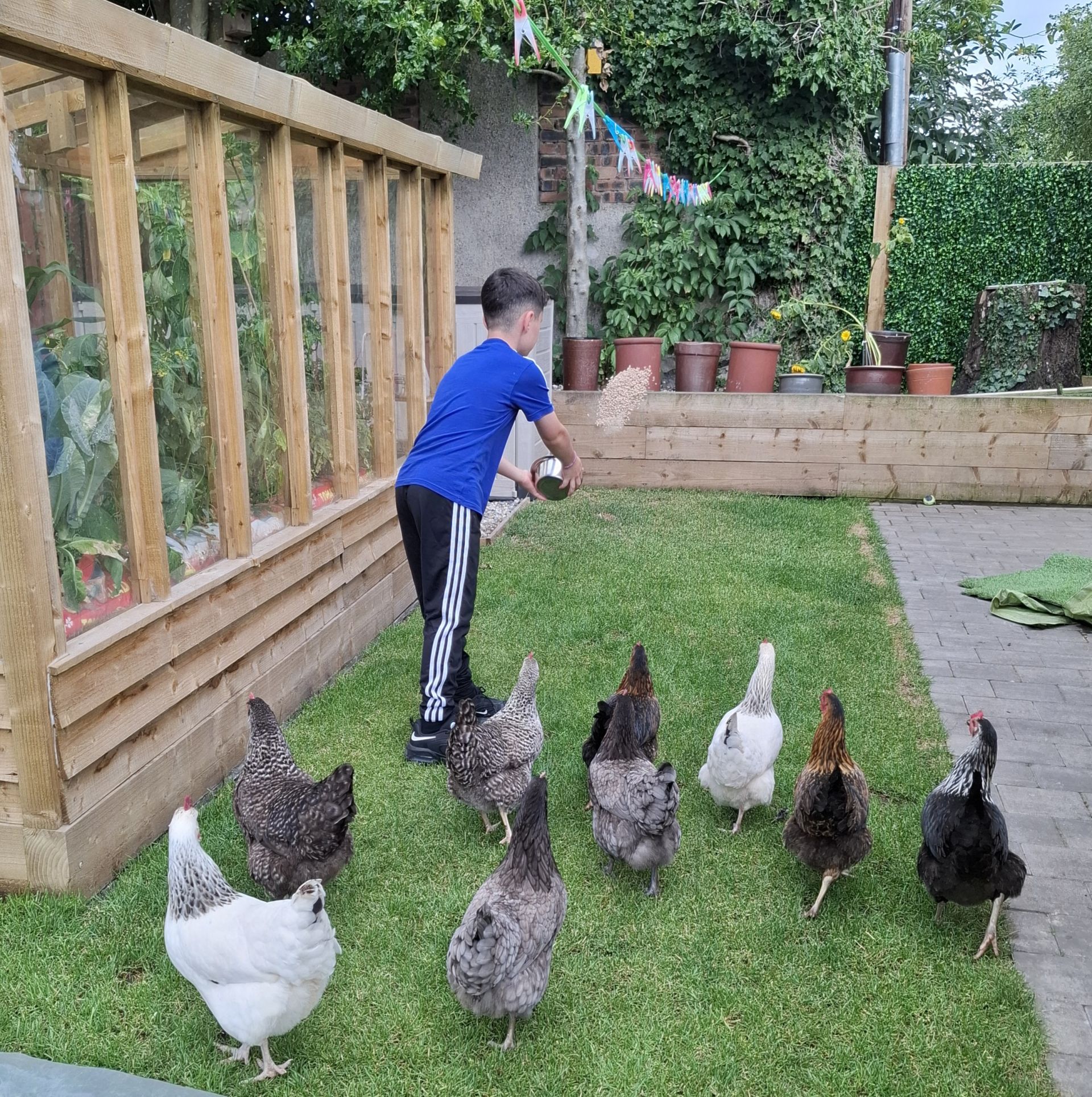
I have learned to prioritise what matters most. Instead of constantly choosing housework, I now make time for activities that feel more meaningful, educational, and natural. For example, last week I left a week’s worth of clean washing on the sofa bed because I chose to go deer stalking, take the dogs for long walks, and clean the chicken coop. The washing annoyed me, but the physical and mental benefits of being outdoors are far greater than the satisfaction of putting laundry away. I share this because it shows that, no matter how busy life gets, we can still make time for the things that matter. Even better, our children are watching and learning from that.
Venison in Our Lives
Before I began deer stalking, I had stopped buying most of my food from supermarkets and started shopping locally at butchers, fruit and vegetable shops, and the high street. At that point, venison was not easy to find. Then I discovered fresh venison at Chatelherault Market on Sundays, and the difference was huge. The taste, texture, and even the colour were completely different from the venison I had bought in supermarkets. That told me a lot.
Venison contains more protein than chicken, and it feels far more natural when it comes from a trained hunter who is registered to sell to the public.
To me, health and fitness are not about body shape. Health comes first; shape comes second. I want to grow older in good health and reduce my chances of developing a long list of health problems. What we put into our bodies affects how we feel, our energy, our happiness, and even how we look. If we do not take care of what we eat, the increased risk of health problems becomes clear in society.
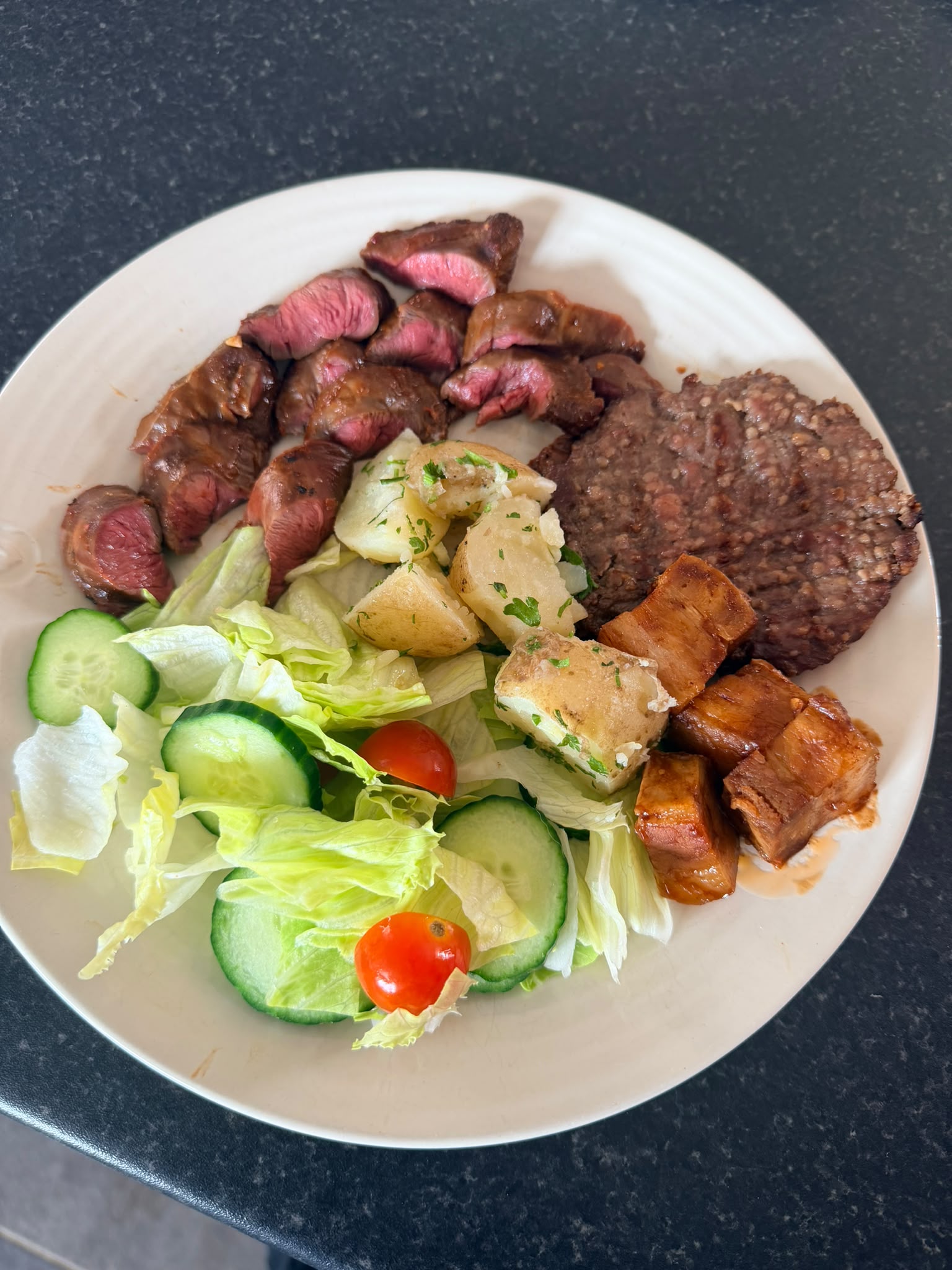
Cooking with venison has become a bit of a running joke in our house. When my children ask what is for lunch, I say, “Eggs and venison.” When they ask about dinner, I say, “Venison and eggs.” It is an amazing feeling to feed my family, including my parents and brother, with venison I have harvested myself and free-range eggs from my own hens.
What People Often Misunderstand
Many people don’t realise that hunting for food has been part of human life for centuries. People also don’t understand that without deer stalking and proper deer management, woodlands can be destroyed. Too many deer damage plants and young trees, and with that loss of vegetation we lose other wildlife too. If deer numbers aren’t managed, it has a knock-on effect on the whole ecosystem — it disrupts the balance of the animals, plants, and food sources.
When I talk to people about venison, a common response is that it can taste too “gamey” or too strong. I explain that the flavour and texture vary depending on the species and age of the deer. Many people do not realise this, so if they try venison that is too strong for their palate, they may assume all venison tastes the same. Wild venison tastes better to me, looks healthier, and is likely to be more nutritious because the animal has lived naturally in the wild. By contrast, factory-farmed animals may not be fed as well and can come with added preservatives.
Going forward, I think product labels should include more detail. Listing the deer species and age would help customers choose the flavour and texture they prefer. For example, someone who wants a milder venison flavour might choose a burger made from young roe deer or a yearling, while someone who prefers a stronger flavour might choose red deer. This would help people find venison that suits their taste while also teaching them that not all wild venison tastes the same.
Confidence
I went into this with confidence, but I underestimated how challenging and difficult it is. I admit there were a few shaky moments when doubt crept into my thoughts, but I don’t give in easily, so I kept at it. Giving up too soon isn’t an option for me. I needed to hang in tight and give it the best chance, so as not to look back and regret giving up too soon. The doubts were mainly to do with who would give me a chance — new girl on the scene with zero experience. There were times I felt that people wouldn’t take me on.
Encouraging Other Women
I highly recommend that women go to females-only “Intro to Deer Stalking” events. I went to one after I qualified with my Level 1. I had a great time meeting other women and I learnt a lot from that day as well.
I think one of the biggest barriers for women is their love of animals and the worry that they could not carry out the gralloching. For women, mothers, or mothers-to-be who feel unsure, I would ask:
• Can you fully trust the food you and your family are eating today?
• What do you think the future will look like for your children when it comes to access to healthy, fresh food?
• Are you aware that UK Research and Innovation has funded research led by the University of Bath into scaling cultivated meat and other cellular agriculture products?
For me, it felt like I had two choices: do nothing and risk my children growing up in a world where real meat is less available and more expensive, or learn the skills now to give them more options in the future.
My advice to women thinking about deer stalking is simple. The only way to know if it is for you is to try. I have always believed in the saying, “Nothing ventured, nothing gained.” I do not want to look back with regret and wish I had given something a chance. It is better to try and know for certain; even if it does not work out, at least you know you gave it a go. For me, the choices I make are not just about me. They are about my children’s future.
I hope this article shows that women with no experience, like me, can learn to hunt, grow food, and look after hens. My advice is to start small. Once you begin, I think you will gain a real sense of satisfaction — and it is even better when your children think you are cool.
What I’d Like to Achieve Next
I want to build on the qualifications I have completed at the academy by gaining more hands-on experience in the different aspects of stalking, pest control, night shooting, butchery, and environmental awareness. Once I have built three to five years of experience, I would like to become a verifier. I already have transferable skills from working in the fitness academy, so the next step is to gain enough field experience to assess students one day.
Get in Touch
If any women would like a buddy to start deer stalking, please get in touch. We can arrange a talk with Chris and Rab, and I’d be happy to join you for your first couple of outings. I really hope this encourages more women to get into deer stalking, and it would be a real pleasure to share the field with other women. I’m sure Chris and Rab would be delighted to support the buddy approach too. Please don’t hesitate to contact me — I’d love to help introduce you to it.
Looking to get into Deer stalking? Enrol today!
Proficient Deer Stalker PDS1 Course
PDS1 is LANTRA and UKRS accredited course delivered by a trusted provider of deer stalker training. The PDS1 is nationally recognised Deer Management course that delivers 'Trained Hunter' status.
Proficient Deer Stalker PDS2 Course
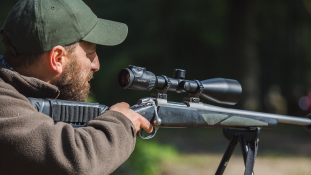
Deer Stalking Qualification that is designed to follow on from the foundation skills achieved during the PDS1. The level 2 course consists of two elements, a taught element delivered online and a practical demonstration of skill by the candidate in the field. Read more
Who we are
The Shooting & Hunting Academy is a UK Registered Learning Provider and LANTRA and UK Rural Skills Approved Training Provider. The academy hosts key accredited courses for those involved in shooting, hunting, the management of wildlife, and the safe and effective dispatch of pests and vermin. The academy also delivers specialist Masterclasses, delivered by leading shooting and environmental experts.